
Introduction
Have you ever wondered why two children born in the same year can have completely different academic abilities? The answer often lies in the difference between chronological age and mental age — two core concepts in psychology and education.
Whether you are a parent, teacher, psychologist, or simply someone curious about intelligence testing, understanding the difference between these two ages is essential. In this guide, we explain both terms clearly, break down the famous IQ formula, and show you how mental age is used in real-world assessments.
What Is Chronological Age?
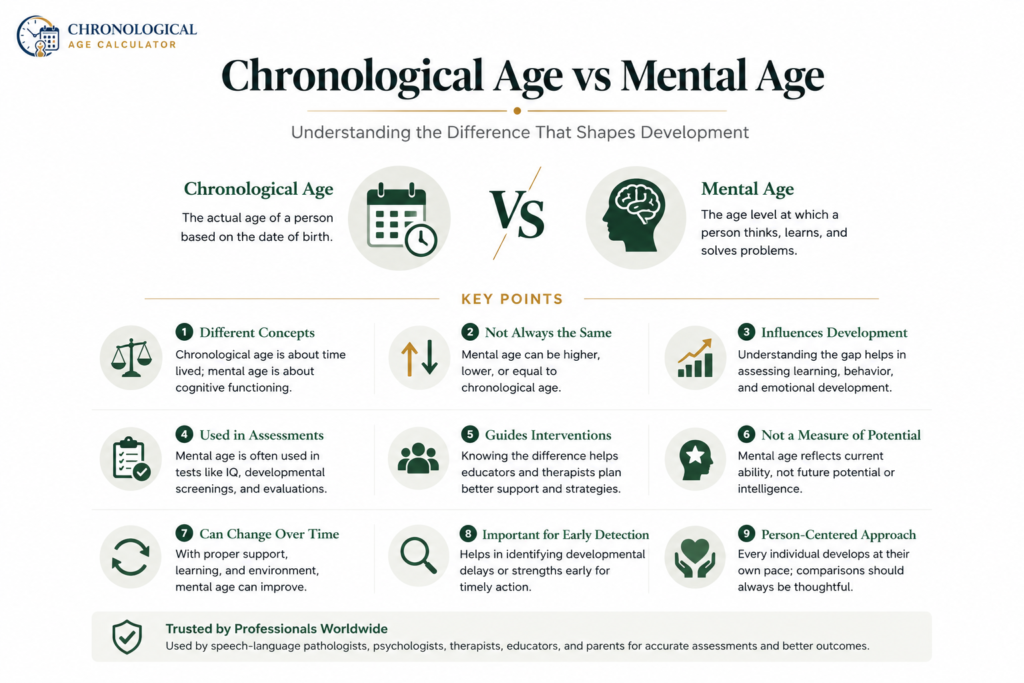
Chronological age is the actual number of years, months, and days that have passed since a person was born. It is a straightforward, calendar-based measurement that is completely objective. Everyone’s chronological age moves forward at exactly the same rate — one year per year, regardless of ability, health, or intelligence.
For example, a child born on 10 March 2016 has a chronological age of exactly 10 years, 2 months, and 7 days on 17 May 2026.
Chronological age is used as the baseline in nearly every psychological and educational assessment. It determines which grade a child attends, which standardised test norms apply, and what developmental milestones are expected.
Key Facts About Chronological Age
- Based purely on date of birth
- Cannot be changed or influenced by any factor
- Used as the denominator in the original IQ formula
- Determines grade placement, legal eligibility, and test norms
- Expressed in years, months, and days for clinical precision
What Is Mental Age?
Mental age is a concept introduced by French psychologist Alfred Binet in 1905. It reflects how well a person performs cognitively compared to the average performance of people of various chronological ages.
In simple terms: if a 10-year-old child scores on an intelligence test at the same level as the average 13-year-old, that child’s mental age is 13 — even though their chronological age is only 10.
Mental age is not fixed. It is a score-based estimate derived from standardised intelligence or cognitive tests. It measures reasoning, problem-solving, verbal ability, and other cognitive skills.
History of Mental Age
Alfred Binet developed the first mental age scale in 1905 to help the French government identify children who needed special educational support. The Binet-Simon Scale assigned age-level scores based on which tasks a child could complete. In 1916, Lewis Terman at Stanford University adapted this work into the Stanford-Binet Intelligence Scale and introduced the now-famous IQ formula.
The IQ Formula: How Mental Age and Chronological Age Are Connected
The original Intelligence Quotient (IQ) formula directly links mental age and chronological age:
IQ = (Mental Age ÷ Chronological Age) × 100
This formula, known as the Ratio IQ, was first proposed by William Stern in 1912 and popularised by Lewis Terman.
How the Formula Works
- If mental age equals chronological age → IQ = 100 (exactly average)
- If mental age is higher than chronological age → IQ is above 100 (above average)
- If mental age is lower than chronological age → IQ is below 100 (below average)
Worked Examples
Example 1 — Above Average: A 10-year-old child has a mental age of 13. IQ = (13 ÷ 10) × 100 = 130 (gifted range)
Example 2 — Average: A 10-year-old child has a mental age of 10. IQ = (10 ÷ 10) × 100 = 100 (exactly average)
Example 3 — Below Average: A 10-year-old child has a mental age of 8. IQ = (8 ÷ 10) × 100 = 80 (low average range)
Chronological Age vs Mental Age: Side-by-Side Comparison
| Feature | Chronological Age | Mental Age |
|---|---|---|
| Definition | Time elapsed since birth | Cognitive performance level |
| Measurement | Calendar (date of birth) | Standardised intelligence test |
| Fixed or Variable | Fixed — always increases | Variable — can differ from CA |
| Used In | Legal, medical, educational | IQ testing, special education |
| Can It Change? | No | Relatively — improves with age |
| Score of 100 IQ | When MA = CA | Average intelligence level |
| Who Uses It | Everyone | Psychologists, SLPs, educators |
IQ Score Classification Chart
Once you calculate an IQ score using mental age and chronological age, here is what the number means:
| IQ Score Range | Classification |
|---|---|
| 130 and above | Very Superior / Gifted |
| 120 – 129 | Superior |
| 110 – 119 | High Average |
| 90 – 109 | Average |
| 80 – 89 | Low Average |
| 70 – 79 | Borderline |
| Below 70 | Intellectual Disability range |
Note: Modern IQ tests use Deviation IQ (not the ratio formula), where scores are compared within the same age group. The mean is always 100 and the standard deviation is 15.
Why Is Mental Age Important in Psychology and Education?
Mental age is used in several key real-world contexts:
1. Special Education Placement Schools use mental age assessments to determine whether a child needs additional support, enrichment programmes, or specialised instruction. A child with a mental age significantly below their chronological age may qualify for an Individualised Education Programme (IEP).
2. IQ and Gifted Programme Identification Children with a mental age considerably above their chronological age are often identified for gifted and talented programmes.
3. Speech and Language Pathology Speech-Language Pathologists (SLPs) use chronological age alongside cognitive assessments to select appropriate test norms for standardised tools like the CELF-5, PPVT, and GFTA-3.
4. Clinical Psychology Psychologists use mental age to assess individuals with intellectual disabilities, learning difficulties, or developmental delays. It helps set realistic goals and expectations.
5. Forensic and Legal Contexts Courts sometimes consider mental age when determining criminal responsibility or guardianship decisions for individuals with cognitive impairments.
Does Mental Age Still Matter Today?
Modern intelligence testing has largely moved away from the original mental age formula. David Wechsler introduced Deviation IQ in 1955 with the WAIS, replacing ratio IQ with a system that compares individuals to peers of the same age group.
However, mental age concepts remain relevant in:
- Early childhood developmental screening
- Assessment of intellectual disability
- Research in cognitive and developmental psychology
- Special education eligibility determination
The Stanford-Binet Intelligence Scale still produces age-equivalent scores that function similarly to mental age, and many developmental assessments report results as age equivalents for ease of interpretation.
Limitations of Mental Age
Mental age is a useful concept but has important limitations:
- It does not measure emotional intelligence, creativity, or social skills
- It can be culturally biased if tests are not appropriately normed
- A single number cannot capture the full complexity of intelligence
- Alfred Binet himself warned against treating mental age as a fixed or permanent measure
- Mental age becomes less meaningful for adults because cognitive growth slows after around age 18
Frequently Asked Questions
What is the difference between chronological age and mental age? Chronological age is the actual calendar age since birth. Mental age is a test-derived score showing the cognitive level at which a person performs, relative to age norms.
What is the IQ formula? IQ = (Mental Age ÷ Chronological Age) × 100. A score of 100 means mental age equals chronological age.
Can mental age be higher than chronological age? Yes. A child with a mental age higher than their chronological age is considered cognitively advanced for their years. This often qualifies them for gifted education programmes.
Is mental age the same as emotional age? No. Mental age refers to cognitive or intellectual performance. Emotional age refers to emotional maturity and regulation, which are separate traits.
At what age does mental age stop being meaningful? Mental age comparisons become less useful after age 18 because average adult cognitive performance does not increase significantly with each passing year.
What tests measure mental age? The Stanford-Binet Intelligence Scale, the Wechsler Intelligence Scale for Children (WISC-V), and the Kaufman Assessment Battery for Children (KABC-II) are the most commonly used tools.
Conclusion
Understanding the difference between chronological age and mental age is fundamental to psychology, education, and child development. While chronological age tells us how long someone has been alive, mental age tells us how that person’s cognitive abilities compare to others their age.
The IQ formula — Mental Age ÷ Chronological Age × 100 — remains one of psychology’s most recognised contributions, even as modern tests have refined the approach. Whether you are calculating eligibility for a gifted programme, assessing a child for special education, or simply curious about intelligence testing, knowing both ages and how they interact gives a far more complete picture of a person’s abilities.